


Children who have had severe malaria:
KCCR is trialling a vaccine in addition to preventive medication
Following a severe bout of malaria, children in endemic areas are often at risk of reinfection, which can lead to a severe course of the disease. The Kumasi Centre for Collaborative Research in Tropical Medicine (KCCR), which is co-run by the BNITM, has therefore launched a research project in collaboration with partners that combines preventive medication with a malaria vaccine.

Many children in Ghana are admitted to hospital with severe malaria or severe anemia. For these children, going home is not the end of the danger: in the weeks and months after discharge, many fall ill again, and some die. Post-discharge malaria chemoprevention (PDMC), a monthly course of dihydroartemisinin-piperaquine for three months, reduces readmission and death, but only while it is taken. Once the course ends, the risk returns.
At the same time, the R21/Matrix-M™ malaria vaccine is delivered to infants through the routine immunisation programme, and older children discharged after severe illness have no structured way to receive it.
PDMCVac brings the two together. The drug protects children through the most vulnerable weeks after discharge, while the vaccine, given at the same time, builds immunity intended to last beyond chemoprevention. Whether children recovering from severe illness mount a good immune response to the vaccine, and whether it is safe to give it together with PDMC, has never been studied.
The study
PDMCVac is a randomised, open-label Phase IIb clinical trial for children aged between 6 and 60 months. Researchers are recruiting 150 children at St Francis Xavier Hospital in Assin Foso in the Central Region. They are randomly assigning children who have had severe malaria or severe anaemia to one of two groups: one receives PDMC with the vaccine, the other PDMC without the vaccine. Healthy children from the local community form a reference group and receive the vaccine. The study primarily investigates whether children develop a good antibody response to the vaccine following a severe illness. It also assesses whether the simultaneous administration of the vaccine and PDMC is well tolerated. It also investigates how long the antibody response lasts and how haemoglobin levels recover. It records cases of malaria, readmissions and deaths in the 15 months following discharge.
Building research capacity
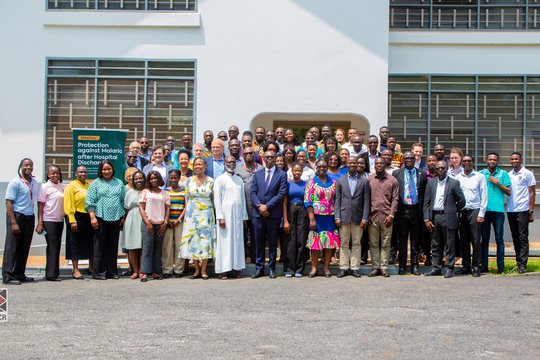
In addition to its scientific objectives, PDMCVac also aims to build research capacity and train specialists in Ghana. The Basic Vaccinology Course took place at the KCCR from 12 to 15 October 2026. The lecturers came from Ghana, Germany, the United Kingdom and Kenya.
Partners and Funding
PDMCVac is jointly managed by the KCCR and the BNITM. The St Francis Xavier Hospital in Assin Foso is conducting the study. University Clinic Hamburg-Eppendorf (UKE) and Jenner Institute at the University of Oxford is also involved in the project. The PharmaVax Ghana Programme is funding the project. The European Union and German development cooperation are co-funding it as part of the Team Europe MAV+ initiative, in collaboration with the Government of Ghana. The German Society for International Cooperation (GIZ) is implementing the project together with its partners. The findings may support future malaria prevention measures in Ghana and beyond.
The launch of the project is an important step towards advancing joint research into integrated malaria prevention. Through the PDMCVac project and the accompanying training programme, the Infectious Disease Epidemiology and Research Group (IDERG) at KCCR and BNITM is further promoting scientific collaboration. In doing so, it is strengthening expertise in vaccine research, clinical trials and public health.
About the Kumasi Centre for Collaborative Research in Tropical Medicine (KCCR)
The KCCR is a joint venture between Kwame Nkrumah University of Science and Technology (KNUST), the Ghanaian Ministry of Health and BNITM. It is based on a state treaty concluded in 1997 with the Free and Hanseatic City of Hamburg. BNITM provides the core funding and is represented on site by several joint research groups. It also contributes to the centre’s strategic direction through the Advisory Board. Key infrastructure, including buildings and laboratories, was established with the support of the Volkswagen Foundation, the German Society for International Cooperation (GiZ) GmbH and the Global Health Protection Programme (GHPP). Over the past ten years, the KCCR has received research funding from at least 50 funding bodies.
Über das Bernhard-Nocht-Institut für Tropenmedizin (BNITM)
Das BNITM ist Deutschlands größte Einrichtung für Forschung, Versorgung und Lehre auf dem Gebiet tropentypischer und neu auftretender Infektionskrankheiten. Aktuelle thematische Schwerpunkte bilden Malaria, hämorrhagische Fieberviren, vernachlässigte Tropenerkrankungen (NTDs), Immunologie, Epidemiologie und die Klinik tropischer Infektionen, Implementation sowie die Mechanismen der Übertragung von Viren durch Stechmücken. Für den Umgang mit hochpathogenen Viren und infizierten Insekten verfügt das Institut über Laboratorien der höchsten biologischen Sicherheitsstufe (BSL4) und ein Sicherheits-Insektarium (BSL3). Neu eingerichtet wurde das Data Science Center. In zahlreichen Ländern des Globalen Südens unterstützt das BNITM beim Aufbau von (mobilen) Laborkapazitäten.
Contact person
Prof. Dr Jürgen May
Head of Dpt. Infectious Diseases Epidemiology
Phone : +49 40 285380-402
Email : chair@bnitm.de
Dr Oumou Maïga-Ascofaré
Co-Investigator
Phone : +233 32 206 0351
Email : maiga@bnitm.de
Wisdom Wemegah
KCCR Media Officer
Phone : +233548952060 / +233201253427
Email : press@kccr.de
Further information