

Reliable AI-based identification of mosquitoes based on their wings
Researchers at the Bernhard Nocht Institute for Tropical Medicine (BNITM) have developed an AI system that automatically identifies mosquito species based on their wing shape.
A team at the BNITM, in collaboration with partners, has developed a freely available application called ITHILDIN. This automatically analyses images of the wings of mosquitoes and other dipterans, enabling it to reliably distinguish between species. The system is much faster than a human and makes fewer errors. This means it can assist both ‘non-entomologists’ and experts with species identification. This is an important step for vector surveillance and research into tropical infectious diseases.

Mosquitoes can transmit pathogens causing malaria, dengue, West Nile fever and other infectious diseases. The level of risk in a particular region also depends on which species are present there. It is therefore important to regularly record which species occur where. Yet this is often where the problem lies: reliably identifying mosquito species is a labourious process and requires experience. Molecular methods can help here, but they are expensive and not available everywhere.
For several years now, researchers have been using the shape of mosquitoes’ wings to distinguish between species. This is based on ‘landmarks’ – predefined points on the wing veins. The coordinates derived from these landmarks can be used to describe the shape of the wing and to compare it across species. The wing is well suited to this purpose because it is flat, can always be photographed in the same position, and requires neither a laboratory nor expensive equipment. Until now, the problem was that these points had to be marked out by hand. This is time-consuming and prone to error.
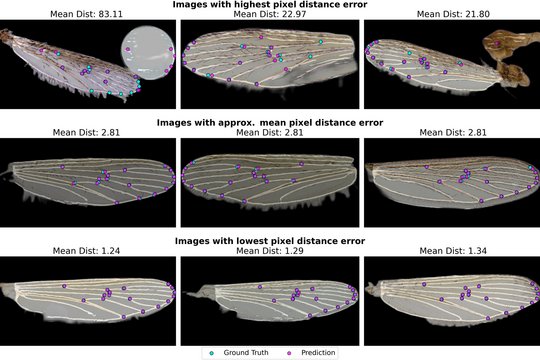
The BNITM team has therefore developed ITHILDIN (‘Integrated Tool for Homologous Image Landmark Detection in Insects using Neural Networks’). The software takes a photograph of a mosquito’s wing, uses image analysis to crop out the wing, automatically recognises the wing veins and places markers at defined points. It then compares the wing shape with those of known species and classifies it as a specific species.
“We wanted to build a tool that not only classifies mosquitoes but also measures them in such a way that we can understand and determine how the AI reaches its decision,” says Kristopher Nolte, lead author of the study and a researcher at BNITM.

More accurate mosquito identification for surveillance and research
The researchers tested ITHILDIN on over 15,000 images of female mosquito wings. The system was able to distinguish between 34 different species and species complexes with over 90 per cent accuracy, setting the landmarks just as well as a trained human. The landmark-based method also performs on a par with traditionally used AI models such as Convolutional Neural Networks (CNN). However, the greatest advantage becomes apparent when ITHILDIN is presented with new data. The researchers replicated an independent study from the Republic of Korea by uploading its images into the public application. Here, ITHILDIN proved significantly more reliable when using landmarks rather than a CNN. This means the approach is also suitable for situations where image quality or imaging techniques vary from study to study.
This provides researchers with a toolkit that goes far beyond mere species identification. For example, differences between populations, as well as the effects of temperature or food availability during the larval stage, can be deduced from wing shape or size. All these factors influence the spread of disease vectors and are the subject of current research.
“We are not yet at the point where a machine can identify all the world’s mosquitoes better than a good entomologist,” say Dr Felix Sauer and Dr Renke Lühken, the study’s last authors. “But we are getting to the point where we can provide both laypeople and experts with a tool that objectively identifies disease vectors. This is a real boon for vector surveillance.”


Background
From mosquito wings to a digital network of measurement points
Landmarks are clearly defined anatomical points – in this case, the junctions of wing veins. They serve as recognisable measurement points. Semilandmarks are situated between these points along the wing veins and describe the shape of the wing in even greater detail.
In the study, the team worked with 17 fixed landmarks on the mosquito wings. Along selected veins, ITHILDIN additionally placed up to 52 semi-landmarks. This combination of a few ‘fixed points’ and many intermediate points allows for a very detailed recording of the wing shape.
How does the AI compare to humans?
The average deviation of the automatically placed points from the human reference was in the range of a few pixels and thus within the margins of error that would also occur between two humans. An established comparison system for automatic landmark recognition performed significantly worse.
Another advantage is that ITHILDIN operates as a ‘single person’ who always measures in the same way. This makes datasets from different research groups more comparable and, for the first time, allows all morphometric studies of dipterans to be consolidated.
Just mosquitoes?
No. The team was able to demonstrate that, with a manageable amount of additional effort, the approach can also be applied to other dipterans. For tsetse flies (Glossinidae) and Drosophila flies, the system achieved similarly precise results for the landmarks. Depending on wing structure, hairiness and image quality, a few hundred additional images are required for calibration.
ITHILDIN is already available online
ITHILDIN is already publicly available as a ‘demonstrator’: anyone interested can upload their own wing images via https://ithildin.bnitm.de and test how the system classifies them.
Funding and collaborations
The work on ITHILDIN was carried out in cooperation with Universität Hamburg and Universität Würzburg and was financially supported, amongst others, by the Federal Ministry of Research, Technology and Space (NEED and CIMT projects), the Klaus Tschira Foundation (Klaus Tschira Boost Fund), the Howard and Gabriele Kroch Foundation, and funding from the EU’s Horizon Europe research programme as part of the ISIDORe/Infravec consortium.
Original publication
Kristopher Nolte et al.: "Automated landmark and semilandmark annotation for wing geometric morphometrics in Diptera using deep learning", Ecological Informatics 99 (2026), 104031. DOI: https://doi.org/10.1016/j.ecoinf.2026.104031
Contact person
Dr Renke Lühken
BMFTR-Junior Research Group Leader
Phone : +49 40 285380-862
Email : luehken@bnitm.de
Julia Rauner
Public Relations
Phone : +49 40 285380-264
Email : presse@bnitm.de
Further information