


Hamburg Bioinformatics Summer School 2026
The BNITM’s Data Science Center warmly invites to the Hamburg Bioinformatics Summer School 2026.
Next-generation sequencing (NGS) and bioinformatics have become essential tools in genetic and genomic analysis. It is increasingly important for experimental scientists to gain the bioinformatics skills required to assess and analyse the large volumes of sequencing data produced by next generation sequencers. During this summer school, participants will have the opportunity to learn about NGS and bioinformatics.
Target audience
This summer school targets those with a specific interest in the analysis of NGS data and bioinformatics and is particularly relevant for PhD students and postdocs from the life sciences. If you are unsure whether you can participate as i.e. an undergraduate or Master student, Principal Investigators, etc., please don’t hesitate to contact us.
Programme
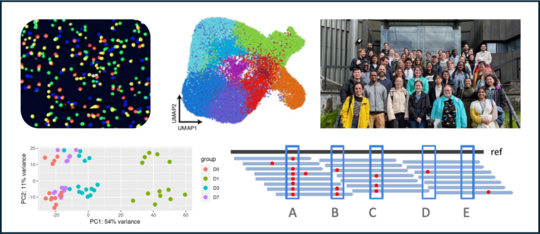
This intensive 5-day summer school provides experimental biologists with hands-on training in analysing omics data using state-of-the-art bioinformatics tools. This course emphasises hands-on practical skills rather than theoretical/mathematical foundations of bioinformatics. Participants will gain practical experience with NGS data analysis, from raw sequencing reads to publication-ready results, while building competency in bioinformatics terminology and underlying concepts.
Topics include
- Basics of Linux
- Introduction to R
- Introduction to next-generation sequencing
- Data visualisation
- Variant analysis
- Transcriptomics: bulk RNA-Seq and single-cell RNA-Seq
- De novo assembly (alternative track to scRNA-Seq)
- Databases & hands on bioinformatics
- Group task to potentially work on own data
Learning objectives
After attending this course, participants should be able to:
- Comfortably work with state-of-the-art bioinformatics software in a Linux-like environment
- Have a good understanding of the application, opportunities, visualisation and analysis of next-generation sequencing datasets
- Integrate and query large-scale genomic and functional genomic databases to answer biology-related research questions and develop testable hypotheses
- Experience analysing RNA-Seq and scRNA-Seq data
- Develop ideas around integrative analysis and how to run basic analysis in R
- Continue to work on their computer when back home
The course culminates in a group project where participants can independently apply their new skills. Participants are encouraged to bring their own data, if desired and can discuss the suitability with the organisers during the course.
Full description
Next generation sequencing (NGS) and bioinformatics has become an essential tool in genetic and genomic analysis. It is increasingly important for experimental scientists to gain the bioinformatics skills required to assess and analyse the large volumes of sequencing data produced by next generation sequencers. With the ongoing omics initiatives, we would like to give PhD students and postdocs the opportunity to learn about NGS and bioinformatics.
This week-long course aims to provide experimental biologists working with omics data with (i) a comprehension of “bioinformatics” language and terminology, (ii) an understanding of the underlying concepts (iii) hands-on experience in genomic-scale data analysis for
- Linux: The operating system for most bioinformatics software. This part will also explain how to process data on a high-performance compute cluster (HPCC each participant will need an account, information to follow). This will allow participants to apply the knowledge they have gained in the future.
- NGS mapping and variant calling: Learn how to map sequencing reads and visualise the data. Find copy number and sequence variants and understand the different types of variation.
- Transcriptomics:
- Analyse a dataset by comparing the transcriptome of a knock-out versus a wildtype parasite - from the mapping of short reads, visualisation, differential expression up to GO enrichment!
- Single cell RNA-Seq - basic introduction using Seurat and 10X Chromium data
- R is a statistical package based on a Linux like syntax. Many tools for genomics and transcriptomics analysis are written in R. We will explore using some of these tools and creating publication-ready figures in R
- Databases: Get an overview of the most common databases and learn how to download published data or perform simple analysis on them.
The data used during the workshop will be derived from bacteria, single celled parasites and human or mouse, but the learning outcomes can be applied to other organisms.
At the end of the course you will have the opportunity to work on a larger task with a group to gain experience of applying the learning outcomes of the course independently. If you wish to bring your own data for the group task, please contact the course organisers in advance.
Initially, participants will work from a virtual machine, which will be provided on a USB hard disc, and can be taken away at the end of the course at no additional cost. Some exercises will be taught on a computer server to practice connecting to servers.
Practical information:
- All practical sessions use Unix/Linux environments. While helpful, no prior Linux experience is required. Data examples include bacterial, parasitic, and human/mouse datasets, with techniques applicable to any organism.
- Please note, that you will need to bring your own laptop, which should have at least 8GB of memory. We believe it is a huge advantage to have your computer set up for bioinformatics.
- Participants receive a USB hard drive with a pre-configured virtual machine to continue learning after the course. However, M1-M5 Macbook users will need to install a specific software before the course.
- There will be an online onboarding session on Friday, 21st August 2026 (via Zoom), if specific software needs to be installed or for trouble-shooting.
- Once your registration is complete, we will be in contact to provide you with further details and to register you on our online Moodle platform where we will be uploading course information and learning materials related to this course.
- Please note, that the course will be cancelled, should the minimum of 15 participants not be reached. In this instance, you will be informed immediately and the course fee fully refunded.
Key Information
Dates: 24-28 August 2026, and 21 August 2026 online onboarding session
Mode: In person on site at the Bernhard Nocht Institute for Tropical Medicine
Timetable: 9:00 am – 18:00 pm each day and additional events on two evenings
Language: English
Course tuition: 1.200 € for academics / 1.500 € for commercial
(incl. course work, course materials, refreshments, lunch, Hamburg “Hafenrundfahrt” (harbour tour by boat, and two dinners).
*It should be noted that no financial aid in the form of scholarships or grants is available from BNITM to cover the costs of participation in the HBSS.
Cancellation policy: A participant who withdraws from this short course:
- less than 6 weeks prior to start date: 25% of the course fee will be charged
- less than 4 weeks prior to start date: 50% of the course fee will be charged
- less than 2 weeks prior to start date: 100% of the course fee will be charged
Selection: Places are assigned on a first-come, first-served basis upon receipt of the fee.
Certificate: Available for those completing at least 80% of the sessions
Online application: Please complete this online application form
Application deadline: 15.06.2026, 23:59 pm, CET., 23:59 pm, CET.
For further information please contact us at: hbss@bnitm.de
About the Organiser

Thomas D. Otto is a bioinformatician by heart with extensive hands-on experience in processing and visualising sequencing data. He holds a diploma in computer science (University of Lübeck, Germany) and a PhD in molecular and cell biology (Fundação Oswaldo Cruz, Brazil).
His expertise ranges from developing software for genome assembly and annotation, studying host specificity, evolution, and host–parasite interactions and applying transcriptomics approaches to problems in Immunology and non-communicable diseases. Currently, his team is working on single-cell and spatial datasets.
Thomas has led more than 60 bioinformatics workshops worldwide and founded the Glasgow Bioinformatics Summer School, which he successfully established as an international training programme. Since 2025, he is Professor of Computational Pathogenomics at the University of Hamburg and the Bernhard Nocht Institute for Tropical Medicine, while keeping an affiliation with the University of Glasgow.
He enjoys teaching bioinformatics, genomics, and how to make clear and attractive figures from complex data.
This course is supported by the interdisciplinary Academy of Competence & Education for Global Health (iACE Global Health)
Eckdaten
Mode: In person at the BNITM
Timetable: 9:00 am – 18:00 pm each day and additional events on two evenings
Language: English
Course tuition: 1.200 € for academics / 1.500 € for commercial
Selection: Places are assigned on a first-come, first-served basis upon receipt of the fee.
Certificate: Available when completing at least 80% of the sessions
Online registration: Please complete this online application form
Registration deadline: 15.06.2026, 23:59 pm, CET., 23:59 pm, CET.
Ansprechperson
Prof. Dr. Thomas Otto
HBSS Coordinator
E-Mail : hbss@bnitm.deDELETETHIS