


Understand infections
How and why do infections occur?
Analysing and modelling infections with tropical and emerging pathogens
A focus of our work is to prevent and fight infections through state-of-the-art epidemiological, ecological and immunological research. The main focus is on infections that affect population groups in resource-poor regions. For epidemiological analyses digital innovations like artificial intelligence for data collection and interpretation are applied. We rely on advanced modeling, big data analytics, and high-resolution satellite imagery to investigate how infections spread and how antimicrobial resistance (AMR) emerges and evolves.
Our expertise in parasitology, entomology and virology is supported by exceptional laboratory infrastructures, including a state-of-the-art biosafety insectary, in Hamburg. Here and in the affected countries, we study how vectors carry and spread pathogens - like mosquitoes transmitting dengue or chikungunya virus. These analyses are essential for identifying conditions under which infections occur and for designing effective strategies to prevent and interrupt transmission. In particular, the influence of climatic variability on the spread of infections is to be analysed in collaboration with climate researchers.
Successful control measures, environmental changes and human behaviour influence the epidemiology of infectious diseases. We therefore want to develop and establish methods for informative surveillance that reliably and continuously records infection dynamics, even in resource-poor regions. We adapt our research and interventions to changing epidemiological realities.
Looking ahead, we are intensifying our efforts for populations under increased risk to infectious diseases. Using mobile laboratories, we carry out risk analyses and field studies in remote and underserved areas. With the support of modern data science, we analyse infection dynamics and model risk patterns for outbreaks. These activities contribute to the development of predictive models and early warning systems that take into account infectious agents in humans, animals and the environment (One Health). The data is collected and stored under conditions that enable artificial intelligence models to be trained.
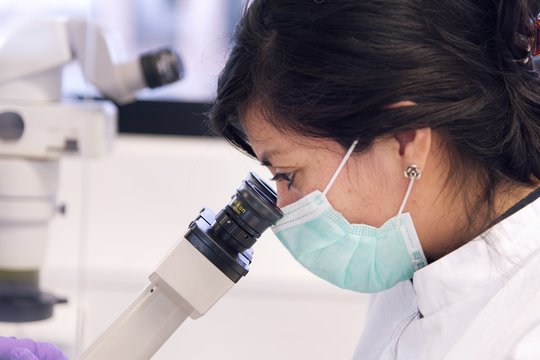
The aim is to gain a more detailed understanding of factors influencing tropical infections. In one aspect, this includes the conditions of pathogen transmission, in particular by mosquitoes. However, a second focus is on human risk factors, in particular genetics and epigenetics as well as social determinants including nutrition and behaviour. In addition, the BNITM is investigating the reaction of the immune system to the invading pathogen. The aim of this interdisciplinary approach is to collect and holistically analyse all important environmental data on infection risks in tropical countries under realistic conditions.
In order to meet the current challenges of tropical medicine, the BNITM offers a broad, state-of-the-art spectrum of methods.
This includes the latest techniques in immunology (in the host and vector) and vector competence analysis as well as the digitised collection and evaluation of data - from modern modelling techniques to the handling of high-dimensional data (big data) and the analysis of high-resolution satellite data. This enables a precise investigation of infection dynamics, in particular of transmission pathways and the spread of antimicrobial drug resistance (AMR), especially in resource-poor regions.
In the future, the BNITM will further intensify its work efforts for the population groups most severely affected by infectious diseases. For this purpose, detailed risk analyses will be carried out with the help of powerful mobile laboratories in remote and neglected parts of certain countries. The Institute carries out these studies in close, trustful partnership with institutions in the respective regions.
Contact
- Dr Anneke Novak-Funk
- Head of Science Management
- phone: +49 40 285380-266
- email: novak-funk@bnitm.de
Downloads
- Scientific report 2023-2024 ( PDF 9 MB )
- BNITM Flyer ( PDF 5 MB )
- Organization Chart BNITM ( PDF 2 MB )
- BNITM Strategy 2030 ( PDF 3 MB )