


Artificial intelligence identifies mosquito species by their wings
BNITM research team develops reliable classification system
Mosquitoes transmit numerous dangerous pathogens such as malaria parasites or viruses such as dengue, chikungunya or West Nile virus. To control mosquitoes effectively, they must be identified accurately. Correct species identification is complicated and expensive due to a lack of experts and the high cost of molecular methods. Artificial intelligence can help to identify mosquito species automatically and reliably. Researchers at the Bernhard Nocht Institute for Tropical Medicine (BNITM) focused on the wings of mosquitoes for this purpose. They developed a machine learning-based system that classifies mosquitoes based on their wing patterns. The research results were published in the journal PLOS Computational Biology.
![[Translate to English:] Vier durch KI generierte Stechmückenflügel verschiedener Spezies sind auf blauen Hintergrund abgebildet.](/fileadmin/_processed_/9/c/csm_KI-generierte_Fluegelformen_0c0692cc49.webp "[Translate to English:] KI-generierte Flügelformen")
Monitoring mosquitoes over large areas is a challenge. But this is precisely what is important in order to be able to issue early warnings and prevent or contain outbreaks of mosquito-borne pathogens. However, there are fewer and fewer experienced entomologists, and complex laboratory tests are expensive. To address this issue, Dr Renke Lühken, head of the BMFTR-funded junior research group Arbovirus Ecology and the Vector Control working group at the BNITM, and his team focused on artificial intelligence (AI):
"Our goal was to develop a reliable and practical AI system that automatically identifies mosquitoes with a high degree of accuracy. In addition, it should work independently of the image capture device used, the experience of the users and the laboratory conditions," says Lühken.
Unique wings
To automatically identify mosquito species, the research team focused specifically on the wings rather than the entire body. This is because the fine vein patterns on the wings – delicate branched lines – are unique to each species, similar to a human fingerprint. In addition, the wings do not change as a mosquito ages or sucks blood, whereas the body can vary greatly. Because wings are flat, it is particularly easy to create standardised images of them. This helps the AI to recognise the patterns of rare species even with just a few examples.

Precise mosquito identification with machine learning
For their system, the Mosquito Wing Classifier, the researchers relied on a special form of AI: a so-called convolutional neural network. This is a network that is particularly well suited for analysing images. After a learning process, such a network can independently recognise structures, patterns or objects. The training process works as follows: the researchers show the network many thousands of already classified wing images. In the process, it learns to extract and classify useful patterns in the images whereby the typical vein patterns in the wings play an important role. At first, the AI makes mistakes and misidentifies species. But it learns from these experiences until it can classify very reliably. In this way, the AI learns independently which patterns belong to which species. The now "trained network" is able to recognise these patterns in new, unknown images and automatically assigns them to the appropriate mosquito species.
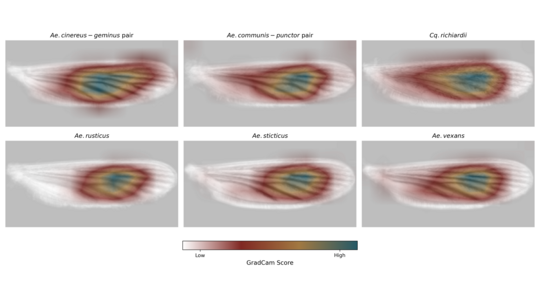
"The system recognises patterns independently, without us having to programme it explicitly. We trained our network with 14,000 wing images from 21 mosquito species, taken with different devices. Our system can now automatically assign new wing images to a mosquito species with 98.2 per cent accuracy," says Kristopher Nolte, lead author of the study and doctoral researcher in the Vector Control group.
Pre-processing the images is key
To ensure that the artificial intelligence recognises the decisive characteristics of mosquito wings and is not misled by trivialities, the researchers developed a multi-stage pre-processing of the images. This removes distractions such as different backgrounds or colour differences.

A key problem with many AI models is that they unintentionally respond to technical details rather than biological characteristics. In experiments, the team demonstrated how such distortions can significantly skew the results: for example, if all images of a particular mosquito species are taken with a smartphone, the AI "learns" to recognise the recording technique rather than the species. This is exactly where pre-processing comes in. It significantly reduces these distortions, even if it cannot prevent them entirely. With highly biased training data, the accuracy of the classification fell below40 per cent despite the pre-processing of the images.
High accuracy, easy to use and open to all
The study shows that artificial intelligence can significantly simplify the identification of mosquito species. The Mosquito Wing Classifier achieved a very high classification accuracy of over 98 per cent, even for species pairs that are difficult to distinguish. In a comparative study, experienced experts achieved an average accuracy of only81.5 per cent when identifying mosquito species from photographs. The AI method proved particularly robust when used with previously unknown recording devices and functioned reliably under real-world conditions. The researchers are making the classification system available as a freely accessible application. It can either be used via a web platform or installed locally on laptops and computers in field stations.

However, the researchers emphasise that the system is currently limited to the species with which it was trained. Further image data is therefore needed for use in other regions or with new species. In the long term, however, the method could also be extended to other insect groups, such as sand flies or midges, which can also transmit pathogens.
"With our system, even people without entomological training can reliably identify mosquito species. All you need is a smartphone with a macro lens," explains Kristopher Nolte. "This can greatly simplify the monitoring of pathogen vectors and help to respond more quickly to new outbreaks."
Contact person
Kristopher Nolte
Working Group Vector Control
Email : kristopher.nolte@bnitm.de
Dr Anna Hein
Public Relations
Phone : +49 40 285380-269
Email : presse@bnitm.de
Further information