


Communication from the US health authority CDC undermines trust in vaccinations
An online survey of nearly 3,000 participants from the US shows a rise in scepticism towards vaccinations and science
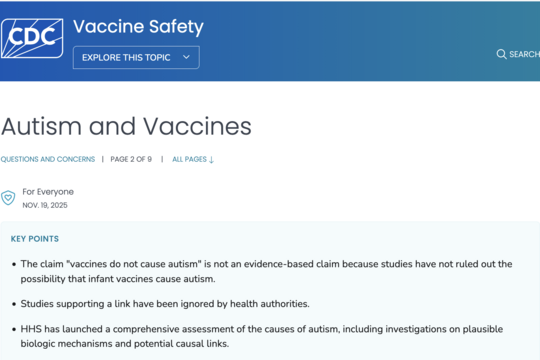
There is a scientific consensus that there is no link between vaccinations and autism. However, the US health authority CDC changed its official communication and instead emphasises that a link cannot be ruled out. An international research team led by the University of Vienna has now investigated the consequences. According to their findings, the CDC’s wording directly encourages vaccine hesitancy and mistrust. The results have been published in the renowned journal Science.

Communication from health authorities can have a major influence on public opinion. In November 2025, particular attention was drawn to the fact that the US health authority, the Centers for Disease Control and Prevention (CDC), changed its official communication on vaccinations and autism on its website under pressure from the Trump administration. In doing so, it highlighted alleged uncertainties regarding the current state of research and called for further investigations into the claimed link between vaccinations and autism. Previously, the CDC had conveyed the scientific consensus that vaccinations are neither causally nor statistically linked to autism. An international research team from Vienna, Erfurt, Hamburg and Copenhagen, led by psychologist Robert Böhm from the University of Vienna, investigated the consequences of this altered communication. Cornelia Betsch from the Bernhard Nocht Institute for Tropical Medicine (BNITM) and the University of Erfurt is a co-author.
The results are clear: those who read the revised message are subsequently less willing to get vaccinated. In general, study participants subsequently trusted the health authority less and were more likely to endorse anti-science attitudes. The societal consequences of such communication are therefore manifold; the researchers advocate for new guidelines to ensure careful and evidence-based communication by health authorities.
Just under 3,000 US citizens took part in the study
In a large-scale online study involving 2,989 adults in the US, the authors investigated how the US health authority CDC’s altered communication strategy affects perceptions of vaccinations and willingness to be vaccinated. In an experiment, participants were assigned to different groups and given different versions of the CDC website to read. Some participants read the earlier version of the CDC statement, which clearly stated the scientific consensus: there is no link between vaccinations and autism. Another group received the newly introduced version, which emphasises uncertainty regarding a possible link between vaccinations and autism. A third group received no such statement.
Doubts rise, vaccination intent falls
The results were clear: those who read the amended information considered side effects of vaccinations to be more likely, had greater concerns regarding vaccine safety and showed a lower willingness to be vaccinated. “Our study shows that the manner of communication itself can be a risk factor,” says psychologist Alina Schneider from the University of Vienna, summarising the findings.
“It is not about systematically concealing scientific uncertainty. What matters is that it is communicated in a way that is consistent with the actual evidence – particularly on topics where there is already broad scientific consensus,” adds Prof. Cornelia Betsch from the University of Erfurt and the BNITM in Hamburg.

A decline in willingness to be vaccinated is not without consequences for public health. “Even a moderate but sustained decline in vaccination rates could lead to more preventable illnesses, greater strain on the healthcare system and rising societal costs,” says Prof. Lau Lilleholt from the University of Copenhagen.
Impact extends beyond the issue of vaccination
However, such shifts in communication can have even broader societal consequences. The message also reduced the study participants’ trust in the health authority, the CDC. At the same time, support for typical strategies of science denial increased – that is, ways of thinking that encourage disinformation, such as selective citation of studies, unrealistic demands for evidence, or conspiracy-like thinking.
High relevance for health communication
The conclusion is clear: changes in health communication are not mere formalities, but can have real effects on trust, attitudes and behaviour. The authors therefore recommend that significant changes to health messages be documented transparently, carefully aligned with the evidence and – where possible – tested in advance to see how they are understood by the public.
“When uncertainty is communicated, this should always be accompanied by a clear contextualisation within the overall state of research and a clear recommendation for action,” urges study lead Prof. Robert Böhm. However, according to the study authors, current communication primarily sows unwarranted doubt and damages trust in health authorities.
About the University of Vienna
The University of Vienna has been setting standards in education, research and innovation for over 650 years. Today, it is ranked among the top 100 – and thus in the top 4 per cent – of all universities worldwide and has a global network. With over 180 degree programmes and more than 10,000 staff, it is one of Europe’s largest centres of academic excellence. Here, people from a wide variety of disciplines come together to conduct cutting-edge research and find solutions to current and future challenges. Its students and graduates tackle complex challenges with a spirit of innovation and curiosity, employing thoughtful and sustainable approaches.
About the Health in Society Research Network at the University of Vienna
Robert Böhm is a professor at the University of Vienna and co-director of the Health in Society Research Network. The research network was founded in 2024 at the University of Vienna. It brings together researchers from different disciplines to jointly explore health, medicine and well-being. Members contribute the specific perspectives of their respective fields, whilst also taking local, regional and global contexts into account.
This holistic approach not only yields new scientific insights, but also fosters valuable partnerships with other research institutions as well as with stakeholders from civil society, politics and business. The research network creates synergies and enables science that has a societal impact – interdisciplinary, innovative and collaborative.
About the Bernhard Nocht Institute for Tropical Medicine
The Bernhard Nocht Institute for Tropical Medicine (BNITM) is Germany’s largest institution for research, healthcare and teaching in the field of tropical and emerging infectious diseases. Current research priorities include malaria, haemorrhagic fever viruses, neglected tropical diseases (NTDs), immunology, epidemiology, implementation and the clinical management of tropical infections, as well as the mechanisms of virus transmission by mosquitoes.
For handling highly pathogenic viruses and infected insects, the institute has laboratories of the highest biosafety level (BSL4) and a biosafety insectarium (BSL3). The Data Science Centre has recently been established.
Original publication:
Böhm, R., Schneider, A., Betsch, C. & Lilleholt, L. (2026) CDC communication undermines trust in vaccines. Science. DOI: 10.1126/science.aef5320
Contact person
Prof. Dr. Robert Böhm
Universität Wien, Fakultät für Psychologie
Phone : +43-1-4277-47332
Email : robert.boehm@univie.ac.at
Prof. Dr Cornelia Betsch
BNITM, Research Group Leader RG Health Communication
Email : cornelia.betsch@bnitm.de
Theresa Bittermann
Universität Wien, Pressestelle
Phone : +43-1-4277-17541
Email : theresa.bittermann@univie.ac.at
BNITM Press
Phone : +49 40 285380-264/269
Email : presse@bnitm.de
Further information