


Why vaccines often work better in women
Certain immune cells may contribute to differences in how effectively vaccines work in women and men.
Vaccines often protect women better than men: women tend to produce more antibodies after vaccination and show a stronger overall immune response. The reasons for this are complex and not yet fully understood. A study led by the Bernhard Nocht Institute for Tropical Medicine (BNITM) now provides new insights: certain immune cells differ in their properties between women and men and may contribute to this stronger effect. The findings have been published in the journal Biology of Sex Differences.

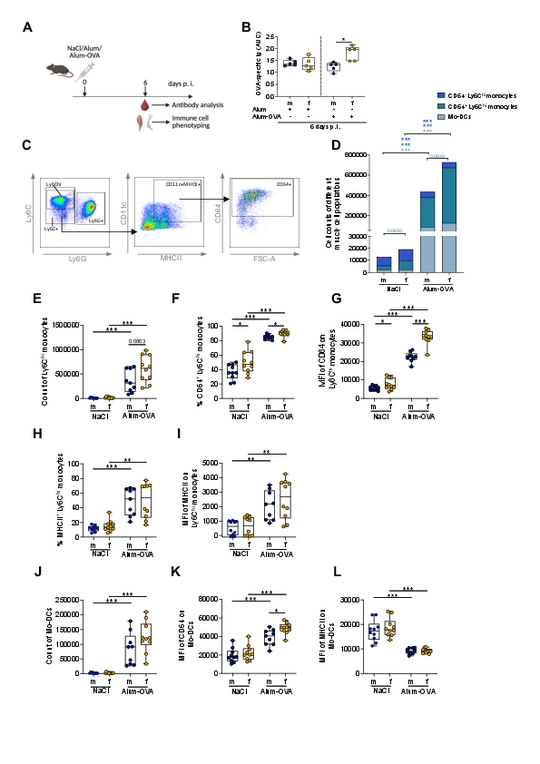
The study focuses on so-called monocytes. These cells recognise pathogens or vaccine components, take them up, and pass this information on to other specialised immune cells (T cells). A receptor called CD64 plays an important role in this process. The researchers show that women and female mice have higher numbers of these CD64-positive monocytes.
Stronger activation of the immune response
In experiments with human cells and in animal models, monocytes from females worked more efficiently: they presented vaccine components more effectively and triggered a stronger activation of T cells. Part of this effect appears to be linked to the receptor CD64, which helps capture vaccine components and make them visible to the adaptive immune system. After vaccination with a model vaccine, cells carrying this receptor were found more frequently in female animals at the injection site and in the lymph nodes – precisely where the immune response is initiated.

“Our results show that differences in certain immune cells may be one reason why vaccines often work more effectively in women,” says first author Dr Charlotte Hansen of the BNITM. “A next step is to determine how strongly these cells actually contribute to protection after vaccination – and whether this knowledge can be used to improve or tailor vaccines.”
Hormones remain an important factor
Previous work – including studies from the Molecular Infection Immunology Group – has already shown that testosterone in particular can dampen immune responses. The current study adds to this picture: when testosterone levels are reduced in male animals, their immune cells respond more strongly to vaccination. At the same time, the findings suggest that these differences cannot be explained by hormones alone.
Relevance for vaccines and medicine
The findings highlight that biological sex shapes immune responses at multiple levels. In the long term, this knowledge could help to develop or tailor vaccines more precisely.
Publication
Hansen et al.: Sex shapes CD64 expression and vaccine-induced monocytic responses, Biology of Sex Differences (2026).
Contact person
Prof. Dr Hanna Lotter
Research Group Leader
Phone : +49 40 285380-475
Email : lotter@bnitm.de
Julia Rauner
Public Relations
Phone : +49 40 285380-264
Email : presse@bnitm.de
Further information