


New insights into the cell biology of malaria and toxoplasmosis parasites
Researchers from Hamburg and Munich pool their expertise
Scientists from the Bernhard Nocht Institute for Tropical Medicine (BNITM) and the Ludwig Maximilian University of Munich (LMU) have discovered how malaria and toxoplasmosis pathogens build and organise their cell structures and transport systems in order to survive. Their discoveries could pave the way for new treatments against these globally significant infectious diseases. The research results were recently published in the Journal of Cell Biology and PLOS Biology.

At the BNITM, the team led by Dr Tobias Spielmann, head of the Malaria Cell Biology working group, together with Dr Richárd Bártfai’s research group Integrative Parasitology from Radboud University Nijmegen, examined the protein complexes AP-1, AP-3 and AP-4 (adapter proteins). They discovered that AP-1, AP-3 and AP-4 play a crucial role in the survival of the malaria parasite. Until now, little was known about how proteins are distributed within the malaria parasite. The researchers have now shown that the adapters ensure that proteins reach their right location within the cell. This transport process is particularly important for the malaria pathogen, as it is necessary both for host cell invasion and intracellular growth.
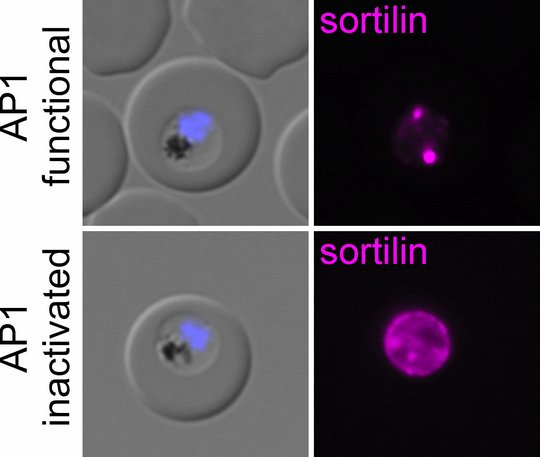
A sophisticated transport system is required to ensure that vital proteins reach the right place within the malaria parasite. This involves the formation of small transport vesicles that carry the proteins to their destination within the cell. Transport proteins help to form these vesicles and load them with ‘cargo proteins’. The AP1 adapter plays a key role in this process. It ensures that the right cargo proteins end up in the right vesicles. One important cargo protein is the transport receptor sortilin (shown in magenta in the images on the right). It binds other cargo proteins, which also end up in the transport vesicles. AP1 recognises sortilin and packs it and its cargo into the right vesicle. This ensures that the cargo reaches the correct destination within the malaria parasite. If AP1 is inactivated (lower row of images), sortilin goes astray: because it is no longer packed by AP1, it no longer ends up in the intended transport vesicles. Instead, it follows an uncontrolled transport flow to the edge of the cell. The cargo then also fails to reach its destination. As a result, important proteins no longer arrive at their site of action and the cell can no longer function. This shows that AP1 is crucial for the correct distribution and transport of important proteins in the parasite. This transport system is therefore essential for the survival of the malaria parasite.
How parasites reuse ancient cell mechanisms
Remarkably, the structure of these transport mechanisms in malaria parasites is similar to that of other organisms, even though the organisms have diverged greatly from each other in the course of evolution. At the same time, the system also has unusual features that were previously unknown.
"Using cutting-edge imaging and protein analysis, we have found that these adapter systems work much like logistics hubs and even share features with similar processes in human cells," says Spielmann.

Prof. Markus Meißner, head of the Department of Experimental Parasitology at LMU, and his team identified a new transport pathway in the parasite Toxoplasma gondii. They investigated a parasite gene that was previously poorly understood. It encodes the protein tepsin, which works closely with the adapter protein AP-4 to ensure that small vesicles within the parasite reach their destination. Interestingly, the structural protein clathrin also plays a role in this process. This mechanism works differently in animals, where the AP-4 adapter complex functions without clathrin. Plants, on the other hand, actively use clathrin to form vesicles. Toxoplasma gondii uses precisely this mechanism. As the study from the Spielmann laboratory shows, this mechanism is also found in the malaria parasite. This discovery shows that Toxoplasma gondii and malaria parasites have developed a highly specialised yet conserved transport system in the course of evolution:
"Our results show that these parasites have retained a very ancient transport mechanism that has been adapted to their unique biology," explains Meißner.
In addition, Dr Simon Gras’s group at LMU discovered that Toxoplasma constantly recycles parts of its outer membrane during as it grows and divides. "We were amazed at how dynamic this process is," says Gras. “It is a brilliant example of how evolution reuses old cellular tricks to solve new challenges.”
Thinking about new therapies
The findings of the research groups from Hamburg and Munich open up new perspectives on the fundamental cell biology of apicomplexan parasites, which include malaria and toxoplasmosis parasites. The work highlights both shared and unique biological characteristics of different species and could contribute in the long term to finding new targets for therapies against malaria and toxoplasmosis.
Two diseases of global significance
Malaria and toxoplasmosis are among the most significant infectious diseases worldwide. Although there are drugs available to treat malaria and toxoplasmosis, they are not effective in all stages of the disease, can have side effects and, in some cases, lose their effectiveness due to resistance. New active substances are needed to combat the pathogens permanently and specifically. Gaining a better understanding of cellular processes is key to identifying new targets for therapies and vaccines.
Malaria and toxoplasmosis are caused by apicomplexan parasites. These are single-celled pathogens that can only reproduce within host cells. Malaria develops when parasites of the genus Plasmodium enter the human bloodstream through the bite of infected Anopheles mosquitoes. They cause high fever, chills and, in severe cases, life-threatening organ damage. According to the WHO, more than 240 million people contract malaria every year. More than 600,000 die as a result, mainly children in sub-Saharan Africa. Toxoplasmosis, caused by the parasite Toxoplasma gondii, affects around one third of the world's population. The infection usually goes unnoticed, but can cause serious complications in pregnant women and immunocompromised individuals.
Publications:
Cubillán-Marín J et al., Vesicle adapters in malaria parasites show conservation and flexibility of protein sorting machinery, Journal of Cell Biology 2025, doi: 10.1083/jcb.202504062
Grech J et al., Tepsin and AP4 mediate transport from the trans-Golgi to the plant-like vacuole in toxoplasma, Journal of Cell Biology 2025, doi: 10.1083/jcb.202312109
Von Knoerzer-Suckow J et al., Plasma membrane recycling drives reservoir formation during Toxoplasma gondii intracellular replication, PLOS Biology 2025, doi: 10.1371/journal.pbio.3003415
About the Bernhard Nocht Institute for Tropical Medicine (BNITM)
The Bernhard Nocht Institute for Tropical Medicine (BNITM) is Germany's largest institution for research, care and teaching in the field of tropical and emerging infectious diseases. Current research focuses on malaria, haemorrhagic fever viruses, neglected tropical diseases (NTDs), immunology, epidemiology and the clinical aspects of tropical infections, as well as the mechanisms of virus transmission by mosquitoes. The institute has laboratories with the highest biological safety level (BSL4) and a secure insectarium (BSL3) for handling highly pathogenic viruses and infected insects.
About Ludwig Maximilian University of Munich (LMU)
Ludwig Maximilian University of Munich is one of Europe's leading universities with a tradition stretching back over 500 years. It offers a broad spectrum of all fields of knowledge – the ideal basis for outstanding research and a challenging range of courses. These range from the humanities and cultural studies to law, economics and social sciences to medicine and the natural sciences. Twenty-two per cent of the 53,000 students come from abroad – from a total of 140 nations. The expertise and creativity of the scientists form the basis for the university's outstanding research record. The success of LMU in all three phases of the Excellence Competition and its continued funding as a ‘University of Excellence’ impressively documents the research strength of the Munich university.
Downloads
Contact person
Dr Tobias Spielmann
Research group leader
Phone : +49 40 285380-486
Email : spielmann@bnitm.de
Dr Anna Hein
Public Relations
Phone : +49 40 285380-269
Email : presse@bnitm.de
Further information
- Cubillán-Marín J et al., Vesicle adapters in malaria parasites show conservation and flexibility of protein sorting machinery
- Grech J et al., Tepsin and AP4 mediate transport from the trans-Golgi to the plant-like vacuole in toxoplasma
- Von Knoerzer-Suckow J et al., Plasma membrane recycling drives reservoir formation during Toxoplasma gondii intracellular replication