


Viral hub
A study by researchers from the Bernhard Nocht Institute for Tropical Medicine (BNITM) and from Hungarian partner institutions highlights Hungary’s central role in the spread of the West Nile virus (WNV) in Europe. Using a One Health approach, the researchers combined data from human and veterinary medicine, mosquito surveillance and viral genomic analysis. This allowed them to trace the relationships between West Nile virus lineages found in Europe and track their spread. The result: many variants of the West Nile virus in European countries originate in Hungary. The researchers identified Hungary as a central hub for the circulation of the virus between birds and mosquitoes and as the main source of genetic WNV diversity in Europe. The study was published in the journal Eurosurveillance.

The West Nile virus (WNV) has been spreading increasingly northwards in Europe for several years now. It circulates primarily between birds and mosquitoes of the genus Culex. Humans usually become infected through mosquito bites, but do not transmit the virus directly from person to person. Most infections go unnoticed: around 80 per cent of those affected do not develop any symptoms. Around one in five infected people develop West Nile fever, which is similar to flu, while fewer than one per cent experience severe neurological complications. Since 2004, Hungary has been considered a major hub for the spread of the virus in Europe. In the country, major bird migration routes intersect with extensive wetlands and favourable conditions for mosquito populations.
The 2024 West Nile season was the most geographically widespread in Europe to date. Hungary experienced a particularly severe outbreak: with the authorities recording a total of 113 human infections, of which 111 were locally acquired and two were imported. Nine of these cases were fatal. This represents a 3.7-fold increase in the number of cases compared to the previous year. Of particular note was the high proportion of severe cases: most patients developed neurological complications, often requiring hospitalisation.
One Health approach combines data from humans, animals and the environment
“We wanted to understand why Hungary was among the hardest-hit countries in Europe during the 2024 West Nile season. To this end, we combined data from human and veterinary medicine and mosquito surveillance with genetic analyses of the virus in order to better understand how the West Nile virus spreads within Hungary and across Europe,” says Dr Dániel Cadar, last author of the study and head of the Virus Metagenomics and Evolution research group at BNITM.

The researchers detected the West Nile virus in almost all regions of Hungary, in humans as well as in birds and mosquitoes. Areas with wetlands, river systems and intensively irrigated agriculture were particularly affected, as these provide ideal conditions for mosquitoes to breed and spread.
Cadar’s team and their Hungarian partners focused specifically on the genetic material of 55 West Nile viruses from humans, birds and mosquitoes. They sequenced the genetic information and then compared it with hundreds of previously known viral genomes from across Europe. Using these genetic ‘family trees’, they could trace the relationships between individual virus variants and track their spread spread across years and countries. The analyses showed that all of the examined samples belonged to the WNV lineage 2, which is predominant in Europe. At the same time, the researchers discoverd an exceptionally high level of genetic diversity in Hungary.

“The West Nile viruses circulating in Hungary belonged to six of the eight main European West Nile virus groups. No other region in Europe has shown comparable diversity so far. This suggests that the West Nile virus has been firmly established in Hungary for many years, with different viral lineages developing and spreading in parallel,” explains Dr Gábor Endre Tóth, another co-author of the study.
Hungary as a hub for the spread of the West Nile virus in Europe
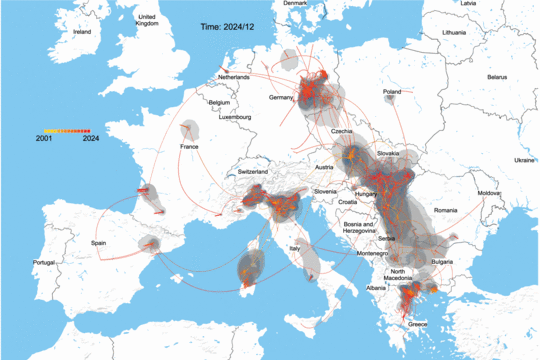
Genetic analyses paint a clear picture: Hungary is one of the most important hubs for the spread of the West Nile virus in Europe. The results show that the West Nile virus not only circulates continuously in Hungary, but has also developed an exceptional genetic diversity, which is then transmitted to other European countries. The researchers found significantly more evidence that virus lineages were transmitted from Hungary to other countries than vice versa. Many virus variants in Austria, Germany, Greece, Serbia and Poland can be traced directly or indirectly to back Hungarian origins. Two major routes of spread emerged. A north-western route leads from Hungary via Austria on to Germany, the Czech Republic and Poland. A second route runs south-eastwards across the Balkans to Greece. In addition, the virus reached more distant areas, including Italy and Spain.
Climate change is facilitating the spread of the West Nile virus
The year 2024 was characterised by exceptionally high temperatures, long periods of drought and subsequent flooding. These conditions extended the mosquitoes’ active season, enabling them to reproduce more successfully and spread more easily over long distances.
“We see climate change as a key driver of the increasing spread of West Nile virus in Europe. Warmer temperatures and longer mosquito seasons could lead to more frequent and larger outbreaks in the future. Outbreaks could also start earlier in the year and reach new regions,” says Cadar.
To be prepared for this, the authors call for closely integrated One Health surveillance that combines data from human and veterinary medicine, mosquito monitoring and environmental observation. They also advocate for greater use of genetic analysis to track the virus’s spread in real time. Climate-adapted early warning and prevention systems, as well as coordinated European measures, are necessary to be prepared for an escalating public health threat posed by the West Nile virus.
Original publication
Nagy A. et al. Hungary as a source of West Nile virus diversity and spread in Europe: insights from the 2024 transmission season. Euro Surveill. 2026, DOI: 10.2807/1560-7917.ES.2026.31.16.2500785
Contact person
Dr Dániel Cadar
Head of RG Virus Metagenomics and Evolution
Phone : +49 40 285380-840
Fax : +49 40 285380-400
Email : cadar@bnitm.de
Dr Anna Hein
Public Relations
Phone : +49 40 285380-269
Email : presse@bnitm.de
Further information