


Research involving animal experiments at the BNITM
„Procedures or treatments carried out on animals for experimental purposes, where these may involve pain, suffering or harm to the animals“ are defined as animal experiments under the German Animal Welfare Act."
The BNITM is dedicated to research, teaching, training, further education and professional development, as well as consultancy and healthcare in the field of tropical diseases and emerging infectious diseases. The focus is on diseases such as malaria, worm infections and other parasitic diseases, as well as infections caused by arboviruses and haemorrhagic fever viruses, and the development of new diagnostic tools. Basic research enables us to gain new insights into the complex biology of pathogens and the disease processes that occur within the host’s body. This is an absolute prerequisite for developing or improving potential drugs and therapies.
The BNITM supports research into 3D organoid models and aims to utilise alternative methods within its own laboratories. Unfortunately, alternative methods that mimic the complex biological interactions are currently available only to a very limited extent. Consequently, in some areas of our research, there remains a need to carry out animal experiments.
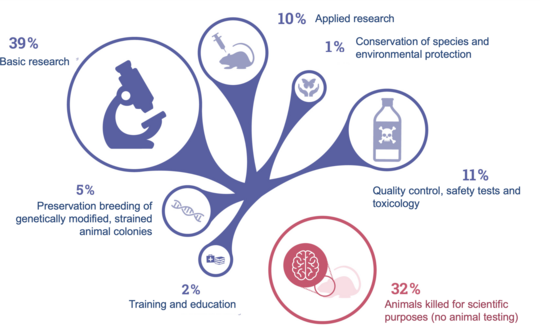
Areas of application for animal experimentation
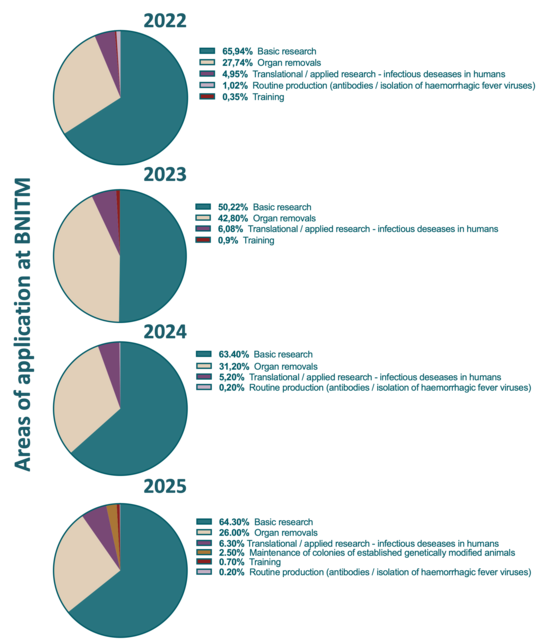
Areas of application at BNITM 2024
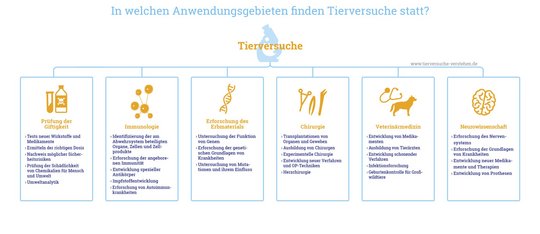
In Germany, animal experiments are carried out in the fields of toxicology, immunology, genetic research, surgery, veterinary medicine and the neurosciences. Animal experiments to develop and test biological weapons, ammunition or other military equipment are not permitted, nor are animal experiments for the development of tobacco products, detergents and cosmetics.
At BNITM, we use animal experiments primarily in the field of immunological and translational infection research and only to a limited extent for other experimental purposes.
Stress levels for animals used in research
Nevertheless, Section 7 of the German Animal Welfare Act permits certain exceptions to this principle. To this end, researchers must be able to justify the purposes of their experiments on ethical grounds and demonstrate that they minimise the expected pain, harm and suffering as far as possible.
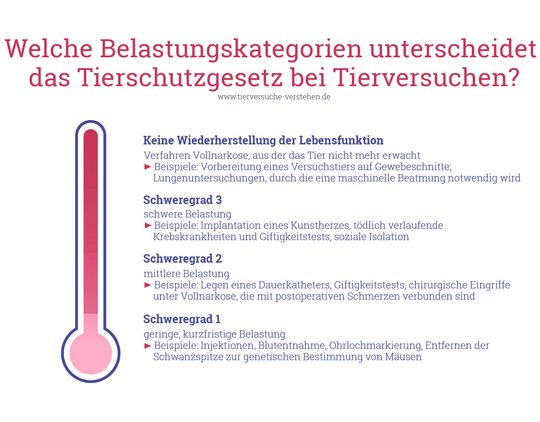
So-called levels of distress help to assess planned experiments in advance with regard to pain, suffering or harm, thereby facilitating the search for less distressing alternatives.
A detailed description of the levels of distress can be found on the website of the ‘Tierversuche verstehen’ initiative under the FAQs (point 12, German only).
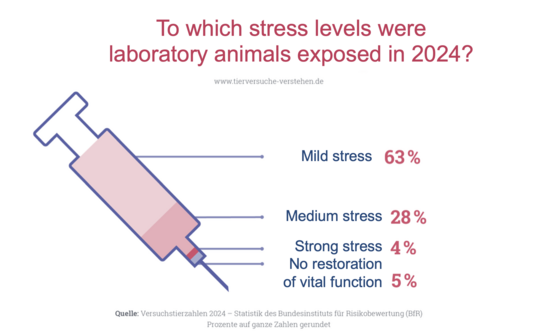
At the BNITM, experiments carried out are mainly those classified as causing low levels of distress. No significant impairment to the welfare of the experimental animals is to be expected. Minor pain, suffering or anxiety, if any, is caused only for a short period. Experiments in which moderate levels of distress are to be expected take place only to a limited extent, whilst those involving severe levels of distress do not take place at all.
Animal Welfare Officer of the BNITM
phone: 040 285380-0 (Reception of BNITM)
email: tierschutz@bnitm.de
Wir beteiligen uns an der

Informationsplattform