



Key activator of the innate immune response against intestinal parasites discovered
With over 1.6 billion people affected, parasitic worm infections represent one of the greatest challenges to global health. Researchers at the Bernhard Nocht Institute for Tropical Medicine (BNITM) have now identified a vital defence mechanism against these parasites. At the centre of this mechanism is a molecule called CD160, which is found on certain immune cells. This study is the first to show that this molecule plays a key role in determining how effectively the body can combat intestinal worms. The findings were recently published in the journal Mucosal Immunology.

It is estimated that a quarter of the world’s population comes into contact with parasitic worms at some point in their lives, particularly in tropical regions. While it is known that the body combats such infections primarily through a so-called type 2 immune response, the exact processes involved are not yet fully understood. In the newly published study, researchers at BNITM used the nematode Strongyloides ratti (S. ratti) as a model to investigate these processes in greater detail. They infected mice with the nematode.
The infectious larvae of S. ratti live in moist soil. They initially penetrate the body through the skin and migrate through tissue to the head region. They are then swallowed and develop into adult worms in the small intestine. The adults worm then lay eggs, which are excreted in the faeces and develop back into infectious larvae. Various immune cells become active to eliminate the worms from the body: among others, immune cells of the innate immune system, the group 2 innate lymphoid cells (ILC2), react rapidly and activate mast cells via signalling molecules. These play a central role in the gut in defending against the worms.
Focus on the checkpoint molecule CD160
CD160 is a small checkpoint molecule on the surface of certain immune cells and functions like a control switch.
“Such checkpoint molecules help the immune system to precisely regulate its activity. This is important so that it can combat pathogens effectively without harming the body itself,” explains Dr Lennart Heepmann, first author of the publication and a postdoc in the Helminth Immunology group at BNITM. “We have now demonstrated for the first time that CD160 is present on ILC2s in the mouse intestine.”

The researchers were also demonstrated that ILC2s divide into two functionally distinct groups during S. ratti infection. One group expresses the CD160 molecule on its surface. These cells proliferate rapidly but produce only a small number of signalling molecules. The second group consists of ILC2s without CD160. These produce large quantities of important type-2 signalling molecules, which activate mast cells and thus trigger the expulsion of the worms from the gut. Importantly, CD160-positive ILC2s can transform into CD160-negative ILC2s that produce signalling moleculs during the immune response.
CD160 plays a crucial rolen in eliminating the parasite
The importance of CD160 became clear in experiments with genetically modified mice lacking the CD160 molecule (CD160 knockout mice). These animals were unable to combat the parasites in their intestines effectively. The infection persisted for an unusually long time, with parasites remaining in the body for weeks and even months, up to around 100 days. By contrast, mice that possessed the CD160 molecule responded much more effectively: their immune systems were able to significantly reduce the parasite burden within a few days. The reason for the prolonged infection in the CD160 knockout mice was that the crucial mast cells were not activated due to the absence of necessary signals from the ILC2. The researchers concluded from their experiments that CD160-positive ILC2s initially proliferate rapidly and subsequently develop into signalling molecule-producing ILC2 that no longer express CD160. The signalling molecules from these CD160-negative ILC2 activate the mast cells, which ultimately ensure that the parasites are expelled from the intestine.
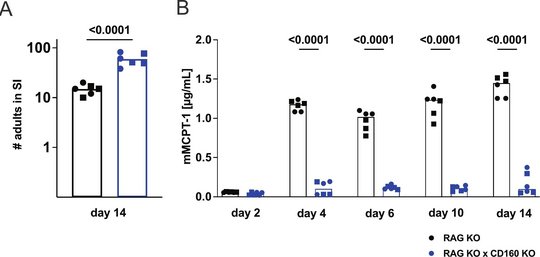

“That really surprised us,” says study leader and head of the research group Prof. Minka Breloer. “Until now, CD160 was primarily known as a regulatory molecule on other immune cells, such as natural killer cells or T cells. Unlike many other checkpoint molecules, which tend to slow down immune responses, CD160 promoted the proliferation and development of important defence cells in our experiments. This opens up a completely new perspective on the regulation of the immune response.”
The researchers also demonstrated that the absence of CD160 in CD160 knockout mice directly caused of the prolonged infection with S. ratti: when they treated already infected CD160 knockout mice with CD160-positive ILC2s, the immune defect was partially reversed. The mast cells became active again and the number of parasites decreased.
New treatment options for other diseases
The findings not only provide a new understanding of how the immune system combats worm infections. They also show that immune cells develop dynamically and change their function during an infection. In the long term, the discovery of CD160-positive ILC2s could open up new approaches for therapies, for example in parasitic infections, but also in allergic diseases such as asthma or other inflammatory diseases in which the type 2 immune response plays a role.
“We see a fundamental mechanism here that could be relevant far beyond this specific S. ratti infection,” says Heepmann. “That is what makes the discovery so exciting. The findings also provide starting points for future immunotherapies, for example in cancer treatment. Through checkpoint molecules, we can specifically intervene in the regulation of immune cells to either enhance or suppress immune responses depending on the disease.”
Immunological background
The innate immune system is the part of the immune defence that reacts immediately to intruders, recognizing them without having to ‘get to know’ them first. It recognises general danger signals and rapidly activates initial protective mechanisms. Worm infections are combated as part of the so-called type 2 immune response. In this process, ILC2s (= group 2 innate lymphoid cells) play a central role. They detect warning signals from the tissue, which activates them. They then multiply and relay the warning signals in the form of signalling molecules such as IL-5 (= interleukin-5), IL-13 and IL-9. In doing so, they activate other immune cells in the process, including mast cells in the gut, which ultimately ensure that the parasites are expelled from the body. While this early response can already significantly curb the parasites, complete elimination also requires the adaptive immune system. This includes, for example, T cells and B cells, which target specific pathogens and build up long-lasting immunity. For the study, the researchers used so-called RAG knockout mice. These animals lack a functioning adaptive immune system, meaning they have no T or B cells. This allowed the researchers to investigate the innate immune defence in isolation. The study demonstrates how crucial the regulation of the early phase of the immune response is for the subsequent course of the infection.
Publication
Heepmann L. et al., CD160-competent ILC2 are crucial for the ejection of intestinal helminths by the innate immune system, Mucosal Immunology 2026, DOI: 10.1016/j.mucimm.2026.04.005
The German Research Foundation (DFG) and the Joachim Herz Foundation provided financial support for the study.
Contact person
Dr. Lennart Heepmann
Research Group Helminth Immunology
Phone : +49 40-285380 -860 -863
Email : lennart.heepmann@bnitm.de
Prof. Dr Minka Breloer
Research Group Leader Helminth Immunology
Phone : +49 40 285380-830
Fax : +49 40 285380-400
Email : breloer@bnitm.de
Dr Anna Hein
Public Relations
Phone : +49 40 285380-269
Email : presse@bnitm.de
Further information