


We take responsibility
Obtaining authorisation to carry out an animal experiment is a complex process. First, the scientists write a corresponding application. In this, they must take various aspects into account. These include a detailed research question, the objectives, insights gained, a precise description of the procedures, assessments of the stress involved, a biometrically and statistically justified number of animals to be used in the experiment, and any potential environmental impacts.
Qualifications and expertise
The German Animal Welfare Act specifies exactly who is permitted to carry out animal experiments (Section 9(1), first sentence, TSchG). The person must hold a university degree in medicine, veterinary medicine or the natural sciences. They must also have completed officially recognised specialist courses. These qualifications are a prerequisite for obtaining authorisation for an animal experiment from the competent authorities in the first place. Furthermore, all persons involved in animal experiments must provide evidence of annual refresher and further training.
Authorisation requirements and supervisory authorities
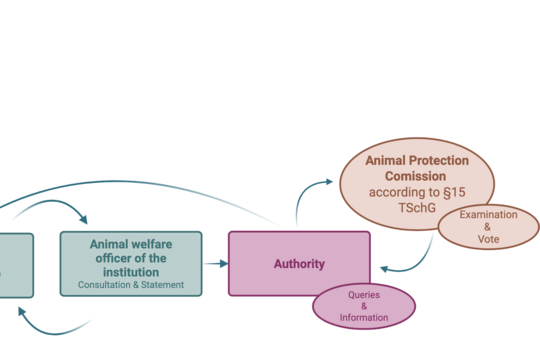
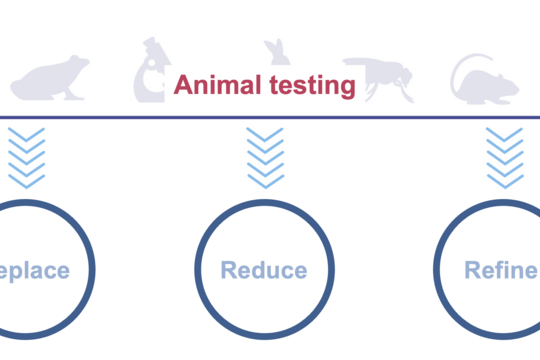
An ethical assessment and evidence that the 3R principle (Replace, Reduce, Refine) is being adhered to are also an essential part of applications for animal experimentation. Following detailed consultation and a written opinion from the animal welfare officer, the application is forwarded to the competent authority. In collaboration with an independent animal welfare commission, the authority carries out a thorough review of the proposed experimental project in accordance with Section 15 of the Animal Welfare Act (TschG). If the experimental project is approved, the authority issues a time-limited authorisation, which may be revoked at any time.
The exact details and legal basis regarding the authorisation requirements can be found on the ‘Understanding Animal Experiments’ website under ‘Law’ and in the FAQs.
The 3Rs principle
In their book “The Principles of Humane Experimental Technique”, the two British researchers William Russell and Rex Burch coined the ethical principle of the 3Rs guideline in 1959. The 3Rs stand for Replace = Avoid, Reduce = Minimise and Refine = Improve.
Every scientist involved in animal experimentation is aware of their responsibility to consistently implement these guiding principles, which contribute to the welfare of laboratory animals.
When planning and carrying out animal experiments, these are, wherever possible, avoided entirely and replaced with alternatives; the number of laboratory animals is reduced to a minimum; and/or the experimental methods used are constantly improved in order to promote the animals’ well-being and minimise their suffering to the extent that is absolutely necessary.
Further information on the 3Rs principle can be found on the website of the ‘Understanding Animal Testing’ initiative.
Animal Welfare Committee at the BNITM
In accordance with Section 6 of the Animal Welfare Ordinance (TierSchVersV), institutions carrying out animal experiments are required to appoint an Animal Welfare Committee (TierSchA). At the BNITM, the Animal Welfare Committee is composed as follows:
the person responsible under Section 11 of the Animal Welfare Act (TierSchG),
the animal welfare officer at our institution,
the senior animal caretaker responsible for animal care,
two researchers conducting animal experiments
and one researcher not conducting animal experiments
The committee meets at least twice a year. Anyone interested can read about the duties of the TierSchA in § 6 (2) 1–7. Primarily, the TierSchA supports the animal welfare officers and, accordingly, assists with the implementation of the 3Rs in our animal husbandry. Among other things, the committee members also monitor the progress and results of animal experiments, taking into account the impact on animal welfare.
If you have any further questions regarding the remit of our Animal Welfare Committee, please feel free to contact tierschutzausschuss@bnitm.de.
Animal Welfare Officer of the BNITM
phone: 040 285380-0 (Reception of BNITM)
email: tierschutz@bnitm.de
Wir beteiligen uns an der
Informationsplattform