


SMART-RSM
Remote Sensing-Guided Malaria Prevalence Sampling in Ghana
Project team at BNITM:
Eva Lorenz (Lead/Contact), Ruud Lucas van den Brink, Jürgen May
Project team at KCCR:
Dr. Oumou Maiga-Ascofaré (Kumasi Centre for Collaborative Research in Tropical Medicine, Ghana)
Malaria burden is routinely estimated from hospital records but this approach systematically misses a substantial share of the parasite reservoir: asymptomatic and submicroscopic infections. Obtaining truly representative population-level prevalence estimates requires surveying households in the community. In rural sub-Saharan Africa, this is complicated by the absence of reliable address systems or up-to-date census infrastructure, making it difficult to construct an unbiased sampling frame.
Project Description:
SMART-RSM develops and validates an innovative population-based sampling framework for cross-sectional malaria prevalence surveys in the Ashanti region of Ghana. The project is embedded within the broader SMART II programme on surveillance of antimalarial resistance and is conducted in close collaboration with the Kumasi Centre for Collaborative Research in Tropical Medicine (KCCR).
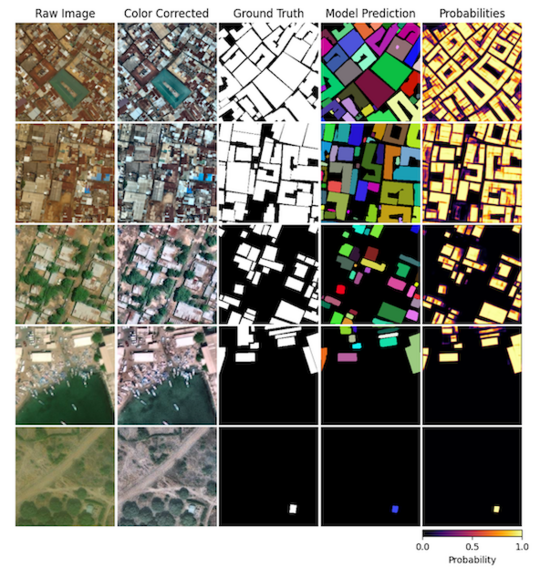
The project is structured in two phases. In Phase 1, a convolutional neural network (CNN)-based instance segmentation pipeline is developed to automatically detect and delineate individual structures from high-resolution satellite imagery (≤ 0.5 m resolution, Pléiades / Pléiades Neo via ESA’s OneAtlas Living Library). The trained model generates a household catalogue for selected districts in the Ashanti region. Hand annotation and field validation are conducted to verify model predictions and correct difficult-to-classify structures. In Phase 2, the validated household catalogue is used to design a two-stage cluster sampling strategy. Selected households are invited to participate in a comprehensive prevalence survey combining rapid diagnostic tests (RDTs), microscopy, and polymerase chain reaction (PCR), enabling detection of clinical, subclinical, and submicroscopic infections. Socioeconomic and behavioural data are collected simultaneously to contextualise malaria risk factors. The resulting framework will be explored for its potential to be replicable and scalable to other districts and disease-endemic settings across sub-Saharan Africa.
The satellite imagery component is supported by an approved data access grant from the European Space Agency (ESA).
Focus Areas:
Epidemiology and population health, geospatial analysis and remote sensing, malaria, computational methods and data science, global health
Glossary:
RSM – Remote Sensing Mapping
| COUNTRY | PARTNER INSTITUTIONS |
| Germany | Bernhard Nocht Institute for Tropical Medicine (BNITM) |
| - Research Group Applied Epidemiology and Biostatistics | |
| Ghana | Kumasi Centre for Collaborative Research in Tropical Medicine (KCCR) |
| - Research Group Infectious Diseases & Epidemiology |
| Funding Period | 2026-2028 |
| Funding Body | German Federal Ministry of Health (BMG) |
| - Global Health Protection Programme (GHPP) | |
| European Space Agency (ESA) | |
| - Project: P0108112 | |
| - Satellite data access via OneAtlas Living Library (SPOT / Pléiades / Pléiades Neo) | |
| GHPP Parent Project | SMART II (Surveillance of Antimalarial Resistance in Ghana II) |
| - PI: Dr. Oumou Maiga-Ascofaré |